Wednesday, November 18, 2015




The NAT Jigsaw Project Experience
 Recently, I was involved in an assignment where I was assigned a Native American tribe and had to become an expert on the tribe in order to teach the rest of the classroom about the tribe and then check for their understanding. We used the Jigsaw Method when completing this lesson. The tribe that my group was assigned with was the Tlingit Tribe. We were given this format to use with the main areas that we needed to cover when creating our presentation to teach the lesson. When my group met up together, we decided that each group member would get 2 areas that they would have to research and become experts at to contribute to the presentation. My role was to become an expert on the clothes that the Tlingit tribe wore and the foods that they ate. My other group members also had 2 other areas that they needed to become experts at. Each member had a role and responsibility for this lesson and an equal amount of work to contribute.
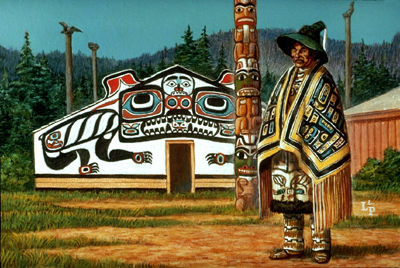
Independently, I took notes and researched both the clothing that the Tlingit tribe wore and the foods that they ate. I learned a lot about these two areas regarding this tribe. We created a PowerPoint on Google Slides to share with one another so that we could each work on the slides together at any time. I condensed the information that I gathered and put it into a short amount of bullet points on the slides. I helped contribute to the pictures and colors that we incorporated into the presentation. I was able to find many pictures that was related to what I found in my research regarding the clothing and food. I also included the Tlingit language into the PowerPoint. For example, "T'A" means Salmon which is considered extremely important to them. My group contributed slides on "Stop and Ponder" where after a certain amount of information is presented to the class, we will bring up review questions so that the students have a better understanding of what they are learning so far.
The Essential Question of this lessons was how geography influenced the Tlingit tribe. With all of our information gathered together, we realized that the tribe's location impacted their diet, trade, clothes, and habitat. In order to give our students the chance to learn more about the Tlingit tribe and extend the lesson even further, we provided a list of books that students can check out to learn more. The conclusion of our lesson included a Google Forms quiz to test their knowledge on what they have learned. Each member contributed 1 or 2 questions to the quiz based on the information that they became experts at.
 I felt that my group worked very well together. It helped prove to me once again that the Jigsaw Method is extremely effective. Each member contributed an equal amount by becoming experts on what they had to research and contributed to the PowerPoint. The PowerPoint came out very well and engaging for the students. When we presented our lesson, it grabbed the students attention and I felt that the students did very well at the quiz. This is a great activity to do to incorporate the Jigsaw Method in the classroom.
Setting It Straight: Primary vs. Secondary Sources
A common mix up that teachers will see occur with students is the confusion between primary and secondary sources.
 Primary Sources are defined as documents (dairies, letters, drawings, memoirs) from the past that gives us witnesses of what occurred. Important historical concepts are exposed to students when they use and analyze primary sources. The students get into the mindset and viewpoint of the author and get exposed to a more personal side of history where students feel the emotions and experience the attitudes of those living during a certain time in the past. When students are using primary sources, they are developing important analytical skills. The students will learn how a point of view affects evidence and can debate about the interpretation of the sources. To give the students examples of primary sources, the teacher can point out that they have their own primary sources such as their birth certificates and social security numbers. To study primary sources for history, students can visit museums and historical societies. More tips about finding primary sources can be found on the Getting Started with Primary Sources website.

There are many ways that you can use primary sources in the classroom, especially for teaching history. Some ideas are to compare a primary source with a source from today, re-create something parallel to the source, apply the source to their own lives, and recognizing point of view and bias attitudes. More ideas like these can be found on the Primary Sources document. Teachers can refer to the Library of Congress website as a resource to find ways to analyze primary sources. They list many reflective questions to help engage the students in their analytical skills.

Secondary Sources are written after an event has occurred. They provide second-hand accounts of a person, topic, or event. Secondary sources interprets and analyzes the primary sources. They can include textbooks, magazine articles, commentaries, journal articles, reference books, etc. Teachers can use secondary sources to compare to primary sources so that students can gain a better understanding of the difference between the two types of sources. This Teaching Primary and Secondary Sources activity is a great activity to use in the classroom to help compare the sources. It is important that students understand the differences between the two sources for their knowledge and to build on their analytical skills.
Tuesday, November 17, 2015
Engaging Ways of Teaching History
 When teaching History, it is important to apply the 5 elements of powerful Social Studies teaching.
The 5 elements are: Meaningful, Integrative, Value-Based, Challenging, and Active.
Lessons become Meaningful when it is engaging to the students and incorporates real world situations into the lessons. They are Integrative when it draws on more than one discipline, subject, or skill. The lessons become Value-Based when there is a sense of democratic values and social responsibility. Students can become Challenged when the lessons incorporate different perspectives and students draw on critical thinking skills. Active lessons should have hands on and/or minds on methods. This includes giving the students the chance to participate or use Manipulatives.
 One way that teachers can make history engaging and enjoyable for students is by using online tools/resources to find interactive activities. By going onto the QR Code Treasure Hunt Generator website, you can learn how to use this fun and interactive activity in your classroom to help engage your students. The teacher can submit a series of questions and answers into the website and it will create QR code for each question. The students must use their phones to scan the QR code with their app in order to receive the question that they must answer. The QR codes will be either distributed in folders with the labeled number of the question or can be distributed around the classroom so that students must search for each question. Students can work in groups and the teacher can see which group gets all the answers the fastest in this treasure hunt activity.
Another way to engage students is with the Visible Thinking website. This website gives many ideas on how to help students think from different perspectives regarding different events in history. One of the examples that this website gives is on the slave trade. The teacher posted an image relating to the slave trade and gave dialogue to the central characters in the picture. The students were assigned to think from various perspectives and discuss how different people may be affected by the image. The students then chose a single perspective to research more about and came up with their own script on what that person might be experiencing or thinking.
It is important for teachers to always look for activities and strategies to use in the classroom. This Strategies to Teach Social Studies document provides many strategies that can be used to teach history. Through my experiences and observations, many of the strategies that are listed were familiar to me.
 One of the strategies that was expressed in the document was Service Learning. This is a strategy that I am not familiar with and have not seen occur in a classroom. In this strategy, students learn through reflection on the experience of serving the community. Students are involved in situations where they can learn and apply their skills. It can be either a long-term or short-term project. I would incorporate this strategy when teaching history by giving the students options in the community of where they can go to learn more about history and give them time to explore and reflect. The students can even present a presentation on what they learned and their experiences at the site. Students can volunteer at local preservation organizations, assist with archaeological digs at historic or prehistoric sites, Testify at public hearings, city council meetings and/or state legislatures, to advocate for historic preservation projects, etc.
Another strategy that was expressed in the document was about the Educators for Social Responsibility (ESR) Model. This is a discussion model to use in the classroom. The 1st step is to present the positions, the 2nd step is for each group to ask questions and then restate the other group's position accurately, the 3rd step is for each group to present a list of agreements between the two positions, and the 4th step is for each group to present the questions that can resolve some of the differences between the two groups. I am unfamiliar with this strategy but it can be used as an effective activity for the classroom. To teach history, I would have the students use this ESR Model as an introductory activity on whether we learn from history or not.
These are some great strategies and resources to use in the classroom. I will continue my search for looking for new ways to engage students in the classroom!
The True Meaning of History
 One of the main components of Social Studies is History. History can be defined and interpreted in many ways. It is the study of the human past that is described in the written documents that are left behind. Historians rely on evidence to construct and interpret accounts of the past.
History can also be defined as the chronological study that interprets and gives meaning to events and applies systematic methods to discover the truth in the storyline of history.
Some of the main questions that we ask of our students about the past includes:
the cause and effects of events
the change and continuity
turning points
using the past for future references
through the eyes of those from the past
 Students act as historians when discovering through lessons and activities. As the role of a historian, students research the evidence of the past. An effective example of an activity where students act as historians is when using artifact bags.
 Artifacts are defined as objects that you find when exploring. This includes primary sources such as documents, letters, journal articles, posters, photographs, paintings, etc. These primary sources are placed into bags and students have to analyze the evidence in order to figure out what they have to do with a specific event or person in history.
When students are exploring through artifact bags. It is important that students handle the artifacts delicately since they are primary evidence from the past. If a student comes across a language that they do not understand, encourage the students to use google translator to translate the language in order to interpret what is written on the artifact.
Dr. Smirnova has shown us her own artifact bag which was based on her own life. The bag included her diploma, a Russian box with an American flag pin inside of it, and a photograph. These artifacts represent personal things that have occurred in her life. We acted as historians in order to discover that these objects connected to her. We analyzed the evidence, researched, and translated the Russian language. We also discovered the 5 W's (Who? What? When? Where? Why? How?) in order to come to a conclusion and see how all of these objects connected to her. This is a great activity to do in the classroom to engage your students in history, especially when they are learning about primary sources. I will definitely be using this artifact bag activity in my future classroom!
Monday, November 16, 2015
Teaching the Concepts of Geography
 Geography is one of the most important topics discussed and explored in Social Studies. In order to teach geography lessons effectively, teachers must know the concepts of geography and explore through some great online tools that they can use for their classrooms.
Geography is defined as the study of places and the relationships between the environment and the people. There are 2 main types of Geography: Physical and Human Geography.
Physical Geography is the study of the physical aspects of the Earth including soil, streams, and mountains. It also is the study of the Earth's climate, seasons, and atmosphere.
Human Geography is the study of the different people and culture on the Earth's surface.
There are 5 Themes of Geography that teachers need to keep in mind when developing their lessons:
1. Location: Students will need to learn the location of places. A location can either be Absolute or Relative. A location is absolute, or specific, when it is the coordinates of a map (longitude and latitude). A location is relative when it is nearby or down the road.
2. Place: it is defined as an area with features that distinguish them from other places. For example, a school is a place because it includes classrooms, a gym, hallways, books, students, etc.
3. Region: it is defined as an area defined by similar characteristics (physical, natural, human, or cultural).
4. Movement: it is the way that information, ideas, and people move from one place to another.
5. Human- Environmental Interaction: Students look at the relationships between the people and the environment. The students explore how people depend, adapt, and/or modify the environment. The students learn how this has both positive and negative effects.
 There are 6 Essential Elements of Geography that teachers use for students to gain a better understanding of geography.
1. The World in Spatial Terms
Students will learn how to use maps and other geographical tools and representations to organize information about people, places, and environments.
2. Places and Regions
Students will create regions to interpret the earth's complexity. The students will also learn how culture and experiences influences the people's perceptions of the places and regions.
3. Physical Systems
Students will shape the patterns and characteristics of the earth's surface.
4. Human Systems
Students will learn about the cooperation and conflict of the people's influence of the earth's surface as well as the characteristics and migration of the human populations.
5. Environment and Society
Students will learn about how the physical systems affect humans and how humans modify the physical environment. Students will also learn about the importance of resources.
6. The Uses of Geography
Students will learn how to apply geography to the past, present, and plan for the future.
 Teachers can use the National Geographic website for resources and activity ideas for teaching geography in the classroom. This website is up to date with recent geographical news as well as lessons and activities. It also has an interactive Globe and Map systems for students to practice using and build their skills on.
These are some great resources and tools to use when creating effective geographical lessons for your classrooms. The real challenge is learning how to incorporate these geographical themes and elements into your lessons. It is important that each theme and element is taught throughout geography lessons in order for students to develop and build on their geographical skills.
Sunday, November 15, 2015
An Excellent Resource Tool for Inquiry Lessons (NCSS)

In order to be an effective teacher, it is important to constantly look for ways to create lesson plans and activities that will get the students engaged in the lesson and give them a better understanding of what they are learning. The National Council for the Social Studies (NCSS) has worked together to create an online resource tool for teachers to use in order incorporate inquiry lessons in the classroom in order to enhance the students' learning.

Inquiry lessons consist of the students following the scientific method format. The students develop a hypothesis relating to the main topic and test their hypothesis with the activity that follows. Inquiry lessons helps builds the skills that the students need for their lives as well as preparing them for the skills needed for college and their careers.
The NYS 3 Teachers Inquiry Model website is a great online resource for teachers to access information, materials, and activity ideas for inquiry-based lessons. It provides explanations and reasons that are needed for inquiry-based lessons in the classroom.

The website also provides inquiry lessons approved by the NCSS. These activities range from kindergarten to grade 12. For example, one of the inquiry lessons is on Needs and Wants for kindergarten. In this lesson, the students follow the inquiry-based format in order to grasp the understanding between needs and wants and which serve as necessary components.

This lesson, including the other examples of the inquiry lessons, follow the Inquiry SS Lesson Plan framework. This framework helps to guide any inquiry lesson smoothly and effectively. The model consists of a compelling question, standards and practices, staging the question, supporting questions, formative performance tasks, featured sources, summative performance task: argument and extension, and taking informed action. This framework is a great model for teachers to create their inquiry lessons.
I definitely recommend that teachers view this website. It is a great resource to use and incorporate more inquiry lessons into the classroom. I will definitely being referring back to this website and using the lesson plan framework in my future classroom.

Subscribe to:
Posts (Atom)